Older Canadian houses usually have clay or concrete tile: short sections laid with small open joints that let water in. Newer houses have perforated plastic, either flexible corrugated polyethylene or rigid PVC. The Part 9 building code wording lists the accepted standards and sets 100 mm as the minimum size. Clay lasts but lets roots and silt in at every joint; plastic is continuous but can crush, sag or blind.
- Part 9 accepts clay, concrete, polyethylene, PVC and corrugated steel drain products made to named standards, at no less than 100 mm.
- Clay and concrete tile takes water in at 6 to 10 mm open joints whose top halves are covered; plastic takes it in through slots or holes.
- Corrugated polyethylene is flexible and quick to lay; rigid PVC holds its grade better and is easier to jet clean.
- Mixed systems are common after partial repairs; the joints between materials are where problems start.
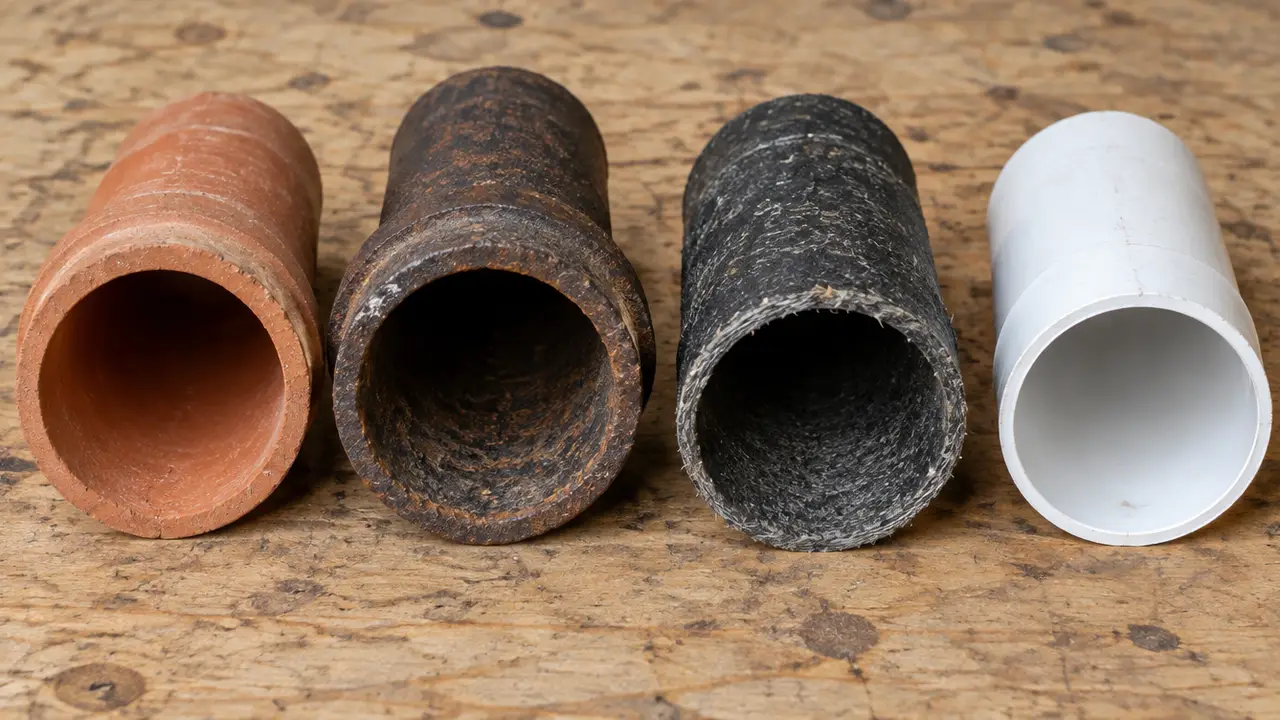
01 /What types of weeping tile are there?
Four families turn up under Canadian houses. The building code lists the standards each one is made to, which is useful when a quote names a product and you want to know what it is. The Part 9 wording reproduced in the 2018 British Columbia Building Code accepts drain tile and pipe meeting ASTM C4 (clay drain tile), ASTM C412M (concrete drain tile), ASTM C444M (perforated concrete pipe), ASTM C700 (vitrified clay pipe, including perforated), BNQ 3624-115 (flexible polyethylene drainage pipe), CSA B182.1 (plastic drain and sewer pipe) and CSA G401 (corrugated steel pipe).
| Type | How water gets in | Strengths | Typical weak points |
|---|---|---|---|
| Clay tile | Open butt joints between short sections | Does not rot or crush easily under soil load | Roots and silt at every joint; sections shift and separate |
| Concrete tile | Open joints, or perforations in perforated concrete pipe | Heavy, stable in place | Same joint problems; can soften in aggressive soil |
| Corrugated polyethylene (PE) | Slots in the valleys of the corrugations | Flexible coils, few joints, light, cheap | Can crush or ovalise under equipment; follows a bumpy trench; corrugations hold silt and ochre |
| Rigid perforated PVC | Two rows of round holes | Holds a straight grade; smooth bore is easy to jet | More joints and fittings; brittle in cold if struck |
02 /How is clay tile different from plastic pipe?
Clay tile is not a pipe with holes. It is a line of short fired-clay cylinders laid end to end on the footing or beside it. The code wording for butt-joint tile calls for joints left 6 to 10 mm open, with the top half of each joint covered by sheathing paper, 0.10 mm polyethylene or No. 15 asphalt or tar-saturated felt. The cover keeps stone and soil from falling into the line; the open lower half lets water rise in.
That design has a built-in weakness. Every joint is an opening several millimetres wide, and every cover can rot or slip over decades. Fine soil washes in, roots find the water, and a slight settlement of the ground pulls tiles apart or lets one drop lower than its neighbour. A plastic line has openings too, but they are narrow slots or small holes along a continuous tube, so there are far fewer places for a root or a slug of silt to take over.
Clay tile fails at its joints; plastic tile fails where it was crushed or laid on a bumpy bed.
03 /Corrugated or rigid: which plastic is better?
Each has a place. Corrugated polyethylene comes in long coils, bends around corners, and can be laid quickly in a trench along a footing. Its corrugations make it strong for its weight, but it follows whatever the trench bottom does, so a lumpy bed becomes a lumpy pipe with low spots that hold water and silt. Under heavy equipment it can flatten.
Rigid perforated PVC in straight lengths holds a steady fall between supports and has a smooth inside wall. Michigan State University Extension, writing about farm drainage where iron ochre is a problem, recommends smooth-interior pipe precisely because jetting cleans it far more easily: ochre and silt have no corrugation valleys to cling to. The trade-off is more joints and more fittings, and each joint must be made properly.
04 /What size is residential weeping tile?
The Part 9 minimum is 100 mm, and 100 mm (4 inch) pipe is what most Canadian houses have. Larger pipe is sometimes chosen for long loops, for systems that collect a lot of groundwater, or where iron ochre is expected; the MSU bulletin suggests a 6-inch rather than a 4-inch lateral in ochre-prone farm fields because the extra room lets a pipe flow longer between cleanings. For a house, the pipe size matters less than the stone, the filter and the outlet.
Solid, unperforated pipe of the same size is used where the line should carry water without collecting it: the run from the loop to the sump or to a storm service, a leader under a driveway, or the section that passes through a footing. Using perforated pipe there lets water leak out along the way.
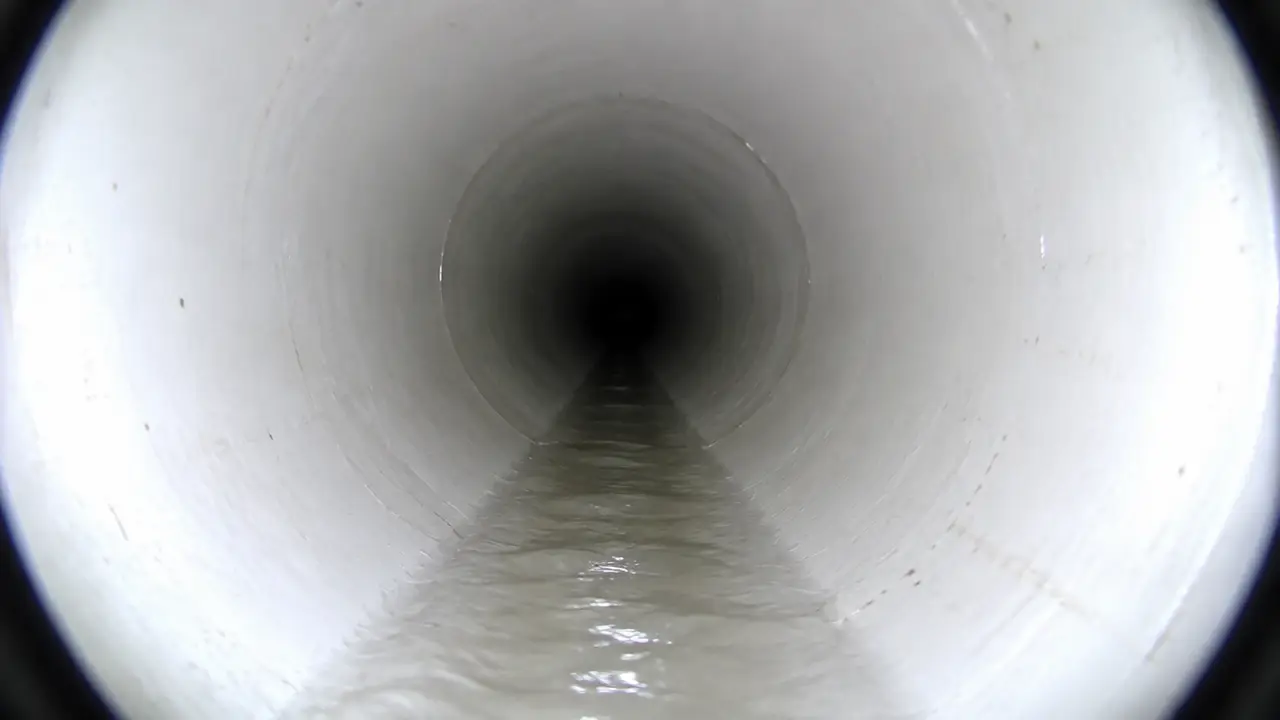
05 /Which fittings and accessories does weeping tile use?
The same small set of parts turns up in every system and in most repair kits sold at building supply stores:
- Couplings or joiners join two lengths of the same pipe. For corrugated tubing they snap over the corrugations.
- Tees and wyes (Y fittings) join a branch to the loop. A wye, set with its branch pointing downstream, also makes a clean access point for a camera or a jetter nozzle, which is why farm drainage guidance recommends wye connections where cleaning is expected.
- Elbows turn corners without crushing the pipe.
- End caps close the upstream end of a run so stone and soil do not fill it.
- Adapters join corrugated tubing to smooth PVC, for example where the loop enters a sump or meets a solid leader.
- Flexible rubber couplings with steel bands, sized for two different outside diameters, join new plastic to old clay during a spot repair.
- Cleanout risers are vertical pipes from the loop up to grade with a removable cap, giving later access for flushing.
- Filter socks and fabric, covered in the sock and filter fabric guide.
06 /Can new plastic tile be joined to old clay tile?
Yes, and it happens on most partial repairs. When a camera finds one crushed or root-filled stretch of clay tile, a contractor digs at that spot, removes the bad sections and lays plastic pipe between sound clay sections, with rubber transition couplings at each end and fresh clean stone and fabric around the new piece. The repaired stretch should match the old line’s grade so it does not create a low spot.
Two cautions. First, the clay on either side is the same age and material as the section that failed, so a spot repair buys time rather than a new system. Second, the joint between materials is the most likely place for the next problem; ask for a camera run through the repair once it is done. When several spots fail, compare the cost of repairs with a full replacement using the Interior vs Exterior Weeping Tile tool and the collapsed weeping tile repair guide.
07 /What about weeping tile under a driveway or garage?
Tile under a driveway or a heavily used path carries traffic loads the rest of the loop does not. Contractors use heavier-walled pipe, deeper cover, or a solid leader in that stretch, and they bed it carefully in compacted stone. If a camera finds a flattened section, check whether it sits under a driveway, a patio laid with a compactor, or the route an excavator took during a past project.
An attached garage usually sits on its own shallower foundation, and the basement wall behind it may never have had exterior tile at all. That is one of the situations where an interior system is often the only practical way to drain the footing. The cost page gives planning ranges for both routes.
FAQQuestions people ask
Is clay weeping tile still installed today?
Rarely in houses. Clay drain tile is still made and is listed in the code standards, but most new residential systems use perforated plastic because it has far fewer joints.
What size is weeping tile on a typical house?
Usually 100 mm (4 inch), which is the Part 9 minimum. Larger pipe is sometimes used on long or very wet systems.
Can I connect new plastic weeping tile to old clay tile?
Yes, with a rubber transition coupling sized for both outside diameters, and with new clean stone and fabric around the repair. Keep the repaired piece on the same grade.
Is rigid PVC better than corrugated weeping tile?
Neither is better everywhere. Rigid PVC holds grade and cleans more easily; corrugated tubing is quicker to lay and has fewer joints. Installation quality matters more than the choice.
Is weeping tile perforated all the way along?
The collecting loop is. Leaders that only carry water to the sump or the storm service should be solid pipe so water does not leak out on the way.
NETWORKGo deeper across the HAUSE Sewer network
How to clean outside drain pipes: downspouts, yard drains and weeping tile
How to clean outside drain pipes in Canada: downspout leaders, yard drains, weeping tile, sump lines and the sewer cleanout, plus thawing frozen lines.
SewerRoots.caRoots in clay and concrete sewer pipe: why older neighbourhoods suffer most
Why roots invade clay and concrete sewer pipe in older Canadian neighbourhoods: joint spacing, mortar and jute seals, mature trees, and how to plan repairs.
SewerJetting.caHydro jetting weeping tile: how foundation drains are cleaned, and when they cannot be
Hydro jetting weeping tile explained: how foundation drains clog with silt, roots and iron ochre, how they are jetted from the sump, and when to replace them.
SOURCESSources and further reading
- British Columbia Building Code 2018, Division B, Section 9.14 Drainage (National Building Code Part 9 wording)
- Michigan State University Extension — Iron Ochre, Bulletin E3453 (revised August 2023)
- B.C. Ministry of Agriculture and Food — Iron Ochre Problems in Agricultural Drains (1988)
- National Research Council Canada — Codes Canada