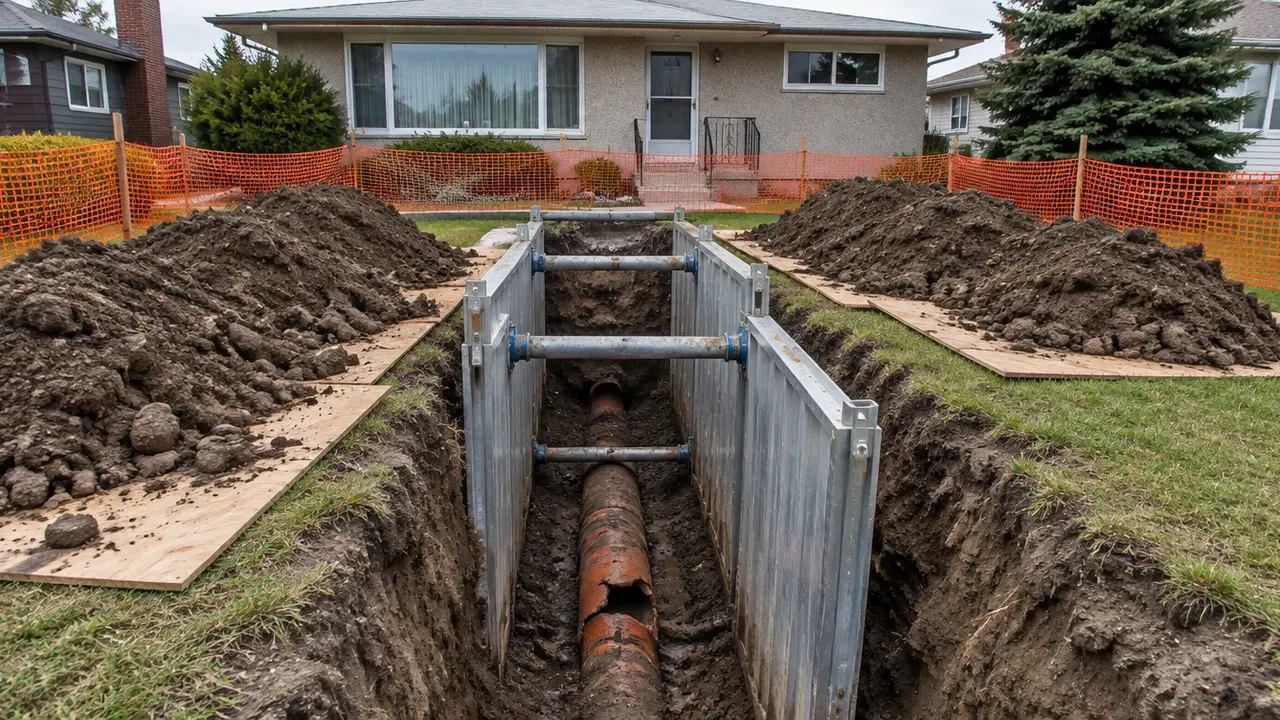
A crushed, collapsed or separated section of weeping tile is found with a camera and a locator, then dug up from outside at that one spot. The broken pipe is cut out, new perforated pipe is joined in with couplings on the same grade, wrapped in fresh clean stone and filter, and backfilled. It works when the rest of the loop is sound; several breaks or failing clay throughout point to replacement.
- Heavy equipment, settlement, frost in shallow sections and shifting clay tile are the usual causes of breaks.
- A camera with a sonde turns a trench into one small hole by locating the break and its depth.
- A spot repair needs the same grade, clean stone and filter as a new system, and a camera run through it afterwards.
- Several breaks, roots at many joints, or tile with no stone around it make a spot repair poor value.
- Call your provincial locate service before any digging, however small the hole.
01 /Can weeping tile collapse or fail?
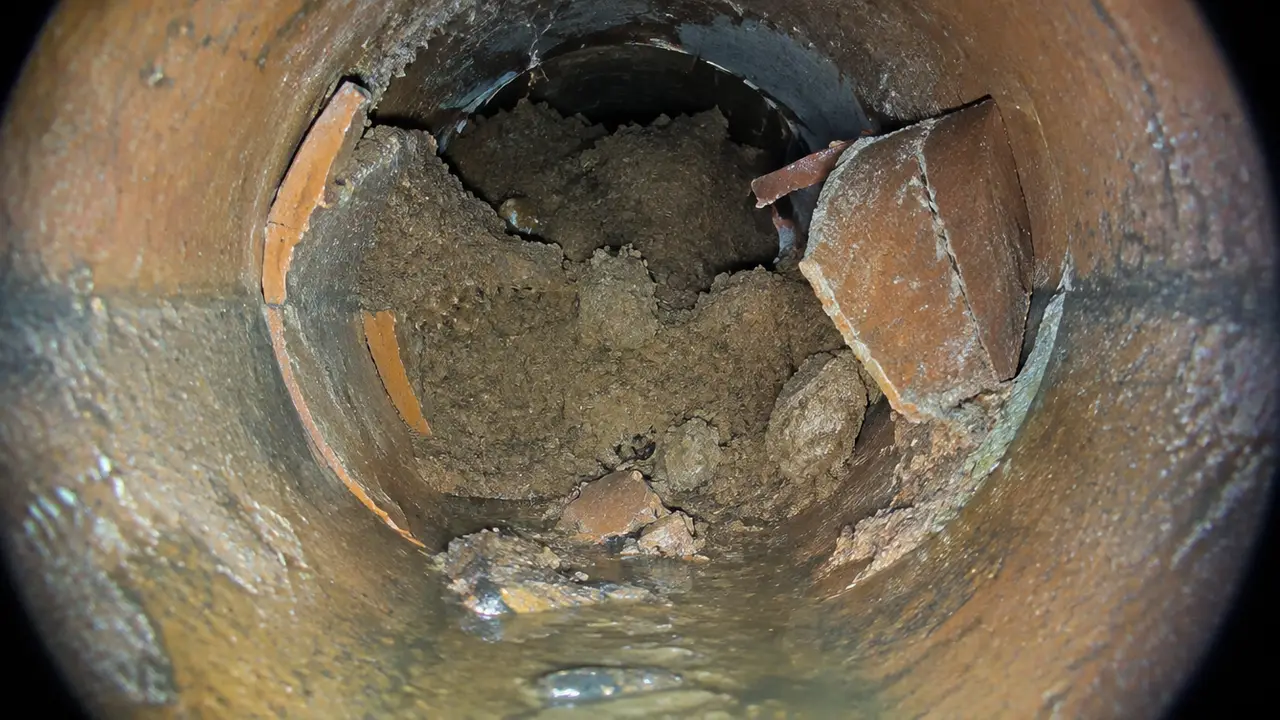
Yes. A foundation drain is a buried pipe that sits beside a heavy wall in soil that moves, freezes and settles, so it can fail like any other buried pipe. The failure that matters most here is structural: part of the pipe is flattened, broken, pulled apart or dropped, so water stops travelling past that point. Upstream of the break the tile fills and overflows; downstream it runs dry.
| Cause | How it breaks the tile | Where to look |
|---|---|---|
| Heavy equipment | A loaded machine or truck over shallow tile flattens plastic or cracks clay | Along the route used during a past landscaping, deck or addition project |
| Settlement of backfill | Loose fill beside the wall settles and drags the tile down, opening joints | Around corners and where backfill was deep |
| Frost | Shallow sections, such as tile at a walkout or under a cleared path, can be heaved | Walkout sides, window wells, near driveways |
| Old clay tile shifting | Short sections drift apart or drop out of line over decades | Anywhere along a clay system |
| Later construction | Footings for decks, additions or fences placed on or through the tile | Beside additions, porches and fence posts |
02 /How is a broken section found?
With a camera from the sump inlet or a cleanout. When the camera stops at the same point on two attempts, or the image shows the pipe pinched shut or daylight and soil through a gap, the operator reads the distance off the counter. A sonde in the camera head is then traced from the surface with a hand-held locator, and the spot is marked on the ground with an approximate depth. That mark is where the hole goes.
Without a locate, a contractor has to guess from the distance and the shape of the house, and a guess usually means a longer trench. It is worth paying for the camera run even when you already know the tile is broken; it also shows whether there is a second problem further round the loop. See weeping tile camera inspection and flushing for what the report should include.
03 /How is a spot repair of weeping tile done?
- Call for locates
Before any digging, contact your provincial locate service (Utility Safety Partners in Alberta, for example) so buried gas, power and communications lines are marked.
- Dig at the mark
Hand-dig or use a small machine to reach the tile beside the footing, keeping the hole tidy and the spoil away from its edge.
- Expose sound pipe both sides
Uncover enough length to reach undamaged pipe beyond the break.
- Cut out the damage
Remove the crushed or separated piece and any silt-filled stone around it.
- Join in new pipe
Fit new perforated pipe with couplings; use rubber transition couplings with bands where plastic meets old clay.
- Check the grade
The repaired piece must fall toward the outlet like the pipe either side, not dip into a low spot.
- Rebuild the envelope
Surround the pipe with fresh washed stone and a filter matched to the soil, then backfill in layers.
- Camera through it
Run the camera past the repair to confirm the join and the flow before closing up, or right after.
The hole is also a chance to add access. A wye fitting with a riser to a cap at grade turns the repair site into a permanent cleanout for future camera runs and flushing.
04 /What can a weeping tile repair kit do?
A repair kit is a set of couplings, often with a short length of pipe, for joining new tile to old once the hole is dug. Kits for corrugated tubing snap over the corrugations; transition couplings with steel bands join plastic to clay or to rigid pipe of a different outside diameter. They make a sound joint, which is the smallest part of a good repair.
What no kit supplies is the rest of the job: the right grade, washed stone, a filter suited to the soil, careful backfill, and proof that the loop now flows. A repair kit used on a pipe that was crushed because it sat in dirty fill under a driveway will be crushed again. The materials and fittings are described in clay vs plastic weeping tile.
05 /When should weeping tile be replaced instead of repaired?
A spot repair is good value when the camera shows one or two breaks in an otherwise clean, continuous pipe that is sitting in stone. It stops being good value when the problem is the whole system rather than one place.
When replacement is the answer, the choice is an exterior system dug from outside or an interior system under a strip of the basement floor. The Interior vs Exterior Weeping Tile tool weighs them for your house, and the two guides explain each: exterior weeping tile replacement and interior weeping tile systems.
06 /What if the break is under a driveway, deck or addition?
Then a spot repair from outside means cutting and replacing the surface on top, or taking down part of a deck or landing, which can cost more than the repair itself. Two alternatives are common. One is to leave the broken exterior section in place and add a short interior drain on that wall, inside the footing, running to the sump. The other, where the damage is limited, is to reroute the exterior loop around the obstacle with a new section and abandon the broken piece.
Which is better depends on how much of the loop is affected, whether the basement is finished on that side, and whether the wall itself is leaking. Water coming through a crack in the wall is a separate foundation repair; drainage lowers the pressure behind it but does not seal it.
07 /What does a broken weeping tile repair cost?
A single spot repair is priced by the contractor on site, because depth, access, surface restoration and the distance of the dig from the sump all change the labour. As reference points from this site’s CAD 2026 planning ranges, the camera run that finds the break is about $250 to $450, and full exterior replacement, dug from outside with a new membrane and tile, is about $250 to $500 per metre of wall. A spot repair on one short section should come in well under what the same length would cost as part of a full replacement plus the fixed cost of getting a machine and crew to site.
The cost page sets out the full list and worked examples, and you can ask HAUSE to pass your camera report to contractors for quotes.
FAQQuestions people ask
What causes weeping tile to collapse?
Heavy equipment over shallow tile, settlement of loose backfill, frost in shallow sections, and old clay tile shifting apart are the usual causes.
Can one section of weeping tile be replaced?
Yes. The break is located with a camera and sonde, dug up from outside, and a new section is joined in on the same grade with fresh stone and filter.
Do I need a permit to repair weeping tile?
It depends on the municipality and the scope. Edmonton’s guide says adding weeping tile needs a plumbing permit. Ask your permit office before a large repair.
Do I need utility locates to dig beside my house?
Yes. Contact your provincial locate service before digging so buried gas, power and communication lines are marked.
Is a weeping tile repair kit enough to fix a break?
The kit only joins the pipes. Grade, clean stone, a filter and careful backfill decide whether the repair lasts.
NETWORKGo deeper across the HAUSE Sewer network
Sewer scope inspections in Edmonton: what to expect and who to call
Sewer scope and sewer line inspection in Edmonton: what mature and newer neighbourhoods show on camera, cold and clay soils, elms, EPCOR and 311 checks.
SewerJetting.caHydro jetting weeping tile: how foundation drains are cleaned, and when they cannot be
Hydro jetting weeping tile explained: how foundation drains clog with silt, roots and iron ochre, how they are jetted from the sump, and when to replace them.
PipeCleaning.caCleaning vitrified clay sewer pipe without breaking it
How to clean vitrified clay sewer pipe safely: root cutting at joints, jetting pressure and nozzles, offsets and cracks, and when clay needs repair.