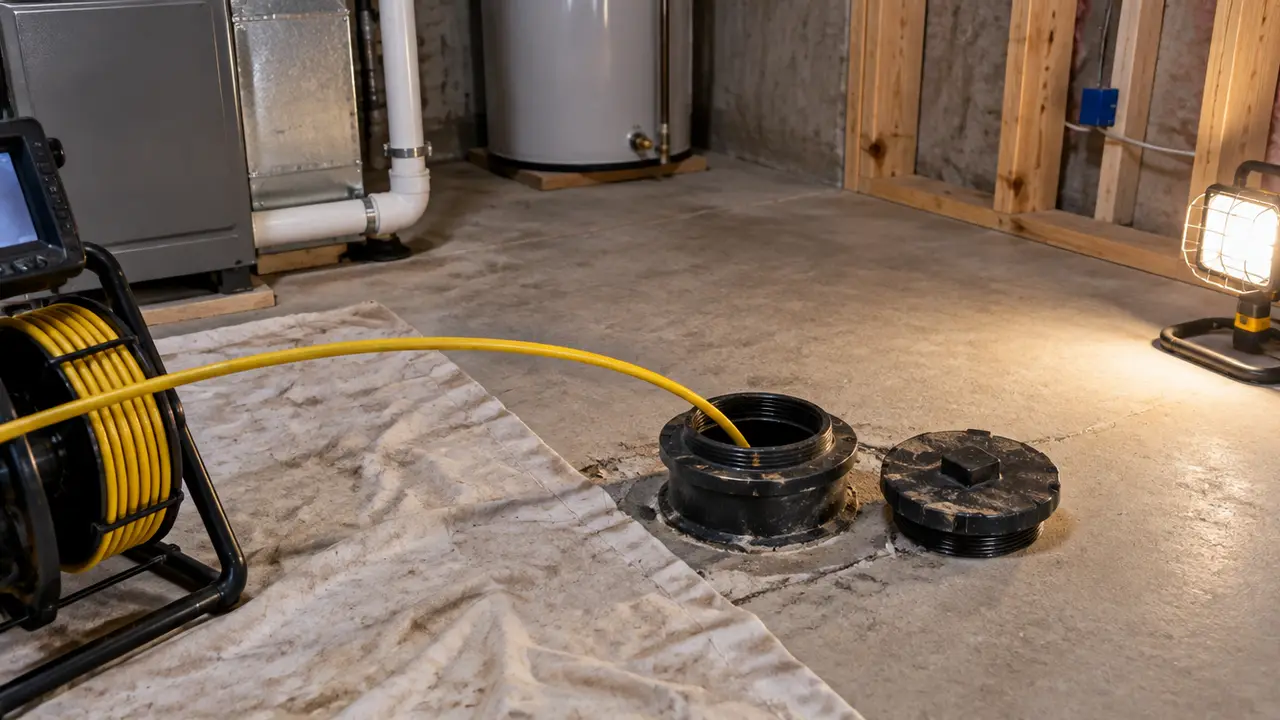
A small push camera is fed into the weeping tile from the sump pit, a cleanout riser or a short dig at a corner, and records the pipe with a distance counter. It shows silt, ochre, roots, breaks and sags. If the pipe is continuous, a jetter nozzle is sent up the same way to loosen deposits, which wash back to the pit. A second camera run confirms the result.
- Access decides everything: the sump inlet, cleanout risers, or a small hole dug at one corner.
- Insist on a recording with footage distances and a locate of any defect, not a live look you cannot keep.
- Flush only a pipe the camera has shown to be continuous; jetting into a break can wash more soil in.
- Nozzle pressure matters in old tile and sandy ground; ask what the operator will use.
- A before-and-after pair of videos is the only proof the flush worked.
01 /Can weeping tile be inspected with a camera?
Yes, as long as there is a way in. Drain cameras small enough for 100 mm pipe are standard equipment for drain contractors. The camera head sits on a stiff push cable wound on a reel, with lights around the lens and a counter that reads out how far the cable has gone. The operator watches a monitor and records the run. Many rigs also carry a sonde, a small transmitter in the head that a hand-held locator picks up from the surface, so a problem found at 11 m can be marked on the lawn with its depth.
The limits are physical. Old clay tile with offset joints can stop a camera head. Tight elbows and tees at corners are hard to push through, and a camera that goes into a tee may take the wrong branch. Corrugated pipe makes the image ripple and hides small cracks. Long loops may need access from both ends to see the whole thing.
02 /Where does the camera go in?
| Access | Where | Notes |
|---|---|---|
| Sump pit inlet | The pipe entering the side of the pit | The most common way in; the pump is unplugged and the pit pumped down first |
| Cleanout riser | A capped vertical pipe at grade or at the basement floor, usually at a corner | Lets the camera or nozzle start partway round the loop; many older houses have none |
| Window well drain | A drain at the bottom of a window well that connects down to the tile | Sometimes usable; often small and full of debris |
| Storm or house drain connection | Where the tile ties into a building drain | Reached from the building drain cleanout; the view shows the connection itself |
| Test dig | A small hole at one corner down to the tile | The fallback where there is no other access; the pipe is cut and a cleanout or wye added |
If your house has no sump and no cleanouts, ask whether the contractor will add a permanent access point during the dig. A wye fitting with a riser to grade costs little once the hole is open and makes every future inspection far simpler.
03 /What does a weeping tile camera inspection show?
| On screen | What it usually means | Typical next step |
|---|---|---|
| Smooth sand or mud along the bottom | Silt entering through a missing, torn or clogged filter, or a gap | Flush, then look for the entry point |
| Orange or brown slime coating the wall and slots | Iron ochre | Flush while soft; plan regular cleaning |
| Fibrous mat or hair-like strands | Roots at joints or slots | Cut and flush; replace that stretch if they return |
| Pipe flattened or oval, camera cannot pass | Crushed section | Locate from the surface and dig at that spot |
| Gap between sections, soil visible | Separated joint | Spot repair |
| Water pooled in a stretch | Sag or belly holding water | Note the length; relay if it collects silt |
| Clean pipe, water flowing | Tile working at that point | Look elsewhere for the water source |
A camera run can also answer the plainest question: is there tile at all, and where does it go? In older houses it sometimes reveals a connection into the house drain instead of a sump, which leads to the options in weeping tile connected to the sanitary sewer.
04 /What should a weeping tile inspection report include?
- A recorded video file you keep, not just a live view.
- The access point and direction for each run ("from the sump, clockwise along the east wall").
- Footage distances for every finding, read off the counter.
- Surface marks and approximate depth for anything that needs digging, found with the sonde.
- The pipe material and size, and where it changes.
- A sketch of the loop with the pit, cleanouts and findings drawn on it.
- A plain statement of what could not be seen and why.
That record is what lets you get comparable repair quotes and, later, compare the same run a year on. In Edmonton, EPCOR also offers a free flood prevention home inspection that reviews drainage inside and out with a checklist; it is a drainage review rather than a camera run of the tile, and it is a useful first visit before paying for one.
05 /How is weeping tile flushed or jetted?
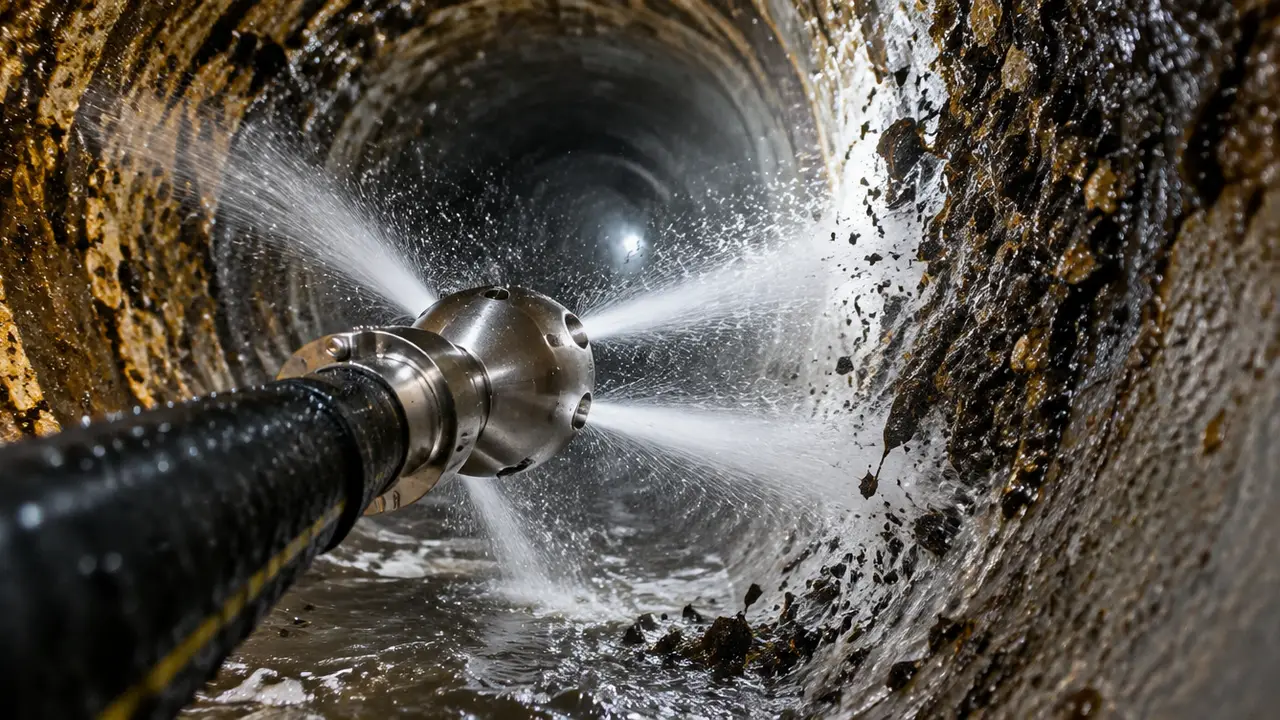
A jetter pumps water at pressure through a hose to a nozzle with jets pointing backwards and sometimes one forward. The backward jets pull the nozzle up the pipe and scour the wall behind it; the loosened silt, ochre and root debris wash downhill behind the nozzle. On a weeping tile loop the nozzle normally goes in at the low end, the sump inlet, and climbs the tile, so the deposit ends up in the pit, where it is vacuumed or bailed out before the pump goes back in service.
- Isolate the pump
Unplug it and lift it out or protect its intake; a pump that ingests a slug of silt and ochre can jam.
- Camera the run
Confirm the pipe is continuous before putting water pressure into it.
- Choose the nozzle and pressure
Match them to the pipe material, its age and the ground around it.
- Work in passes
Advance a few metres, pull back to let the deposit wash out, advance again.
- Clean the pit
Remove what came out so it does not go straight back into the pump.
- Camera again
Record the cleaned pipe so you have a baseline.
Pressure is the question to ask. Old clay tile and thin plastic are not sewer pipe, and the stone and filter around them can be disturbed by a strong jet. Farm drainage guidance from the British Columbia Ministry of Agriculture and Food kept nozzle pressure at or below 2,750 kPa, roughly 400 psi, in sandy soils so the jet would not damage the envelope around the pipe and sweep sand in. For fresh ochre, Michigan State University Extension also describes a low-pressure flush: fill the blocked pipe with water, then release it all at once.
06 /Can a homeowner flush weeping tile?
Partly. With the pump unplugged, running a garden hose into a cleanout riser and watching whether the water arrives at the pit is a fair test of whether the loop is open between the two points. A small sewer jetter attachment for a pressure washer will move soft, loose material in short runs close to the pit. Neither will clear packed silt, root mats or hardened ochre, and neither shows you what is in the pipe.
Where homeowners get into trouble is forcing water into a pipe with a break in it, or running a pressure washer into old clay tile. If the hose test shows water not arriving, the next step is a camera, not more pressure. Use the Weeping Tile Problem Finder to check whether the pump or the outlet is the likelier problem first.
07 /What does inspection and flushing cost?
As CAD 2026 planning estimates used across this network, a standalone camera inspection runs about $250 to $450. A visit that combines a camera run with jetting from the sump runs about $400 to $1,200, depending on how long the loop is, how many access points there are, and how heavy the deposit is. A dig to create access where none exists is extra and is priced by the contractor on site.
If the video shows a break, the next read is collapsed weeping tile repair; if it shows a system beyond repair, the cost page and the Interior vs Exterior Weeping Tile tool help size the replacement. You can also send the video to HAUSE with your request.
FAQQuestions people ask
How far can a camera go into weeping tile?
As far as the cable reaches and the pipe allows. Offset clay joints, tight corners and crushed sections stop a camera sooner than cable length does.
Do I need to empty the sump pit for a camera inspection?
Yes. The pump is unplugged and the pit pumped down so the camera can enter the inlet and the view is not under water.
Will flushing damage old clay weeping tile?
It can if the pressure is too high or the pipe is already broken. A camera run first and a moderate nozzle pressure reduce the risk.
Where does the dirt go when weeping tile is jetted?
Downhill with the water, usually back to the sump pit, where it is removed before the pump goes back into service.
Can a camera tell if weeping tile goes to the sanitary sewer?
Often. A camera run from the building drain cleanout can show a tile connection entering the drain.
NETWORKGo deeper across the HAUSE Sewer network
Hydro jetting weeping tile: how foundation drains are cleaned, and when they cannot be
Hydro jetting weeping tile explained: how foundation drains clog with silt, roots and iron ochre, how they are jetted from the sump, and when to replace them.
PipeCleaning.caCleaning vitrified clay sewer pipe without breaking it
How to clean vitrified clay sewer pipe safely: root cutting at joints, jetting pressure and nozzles, offsets and cracks, and when clay needs repair.
SewerQuotes.comSewer camera inspection cost, and what the fee should include
Sewer camera inspection cost in Canada for 2026: standalone, pre-purchase and add-on scope prices in CAD, what a proper report includes and when the fee is wasted.