Weeping tile clogs in three main ways: fine silt washes in and settles, iron ochre bacteria coat the openings in orange slime, or roots grow in through joints. Signs include water at the wall–floor joint after rain while the sump pit stays dry, and mud or orange slime in the pit. A camera run identifies the cause; flushing from the pit or a cleanout clears most clogs if the pipe is intact.
- A sump pit that stays dry while the basement gets wet is the clearest sign the tile is not delivering water.
- Silt is a filter problem, ochre is a chemistry and bacteria problem, and roots are a joint problem; each needs a different follow-up.
- Iron ochre is easiest to remove while fresh; left to harden it can become very difficult to clear.
- Check the pump and the discharge outlet before blaming the tile; a frozen hose looks the same from inside.
- Flushing only helps a pipe that is still continuous, so a camera run should come first.
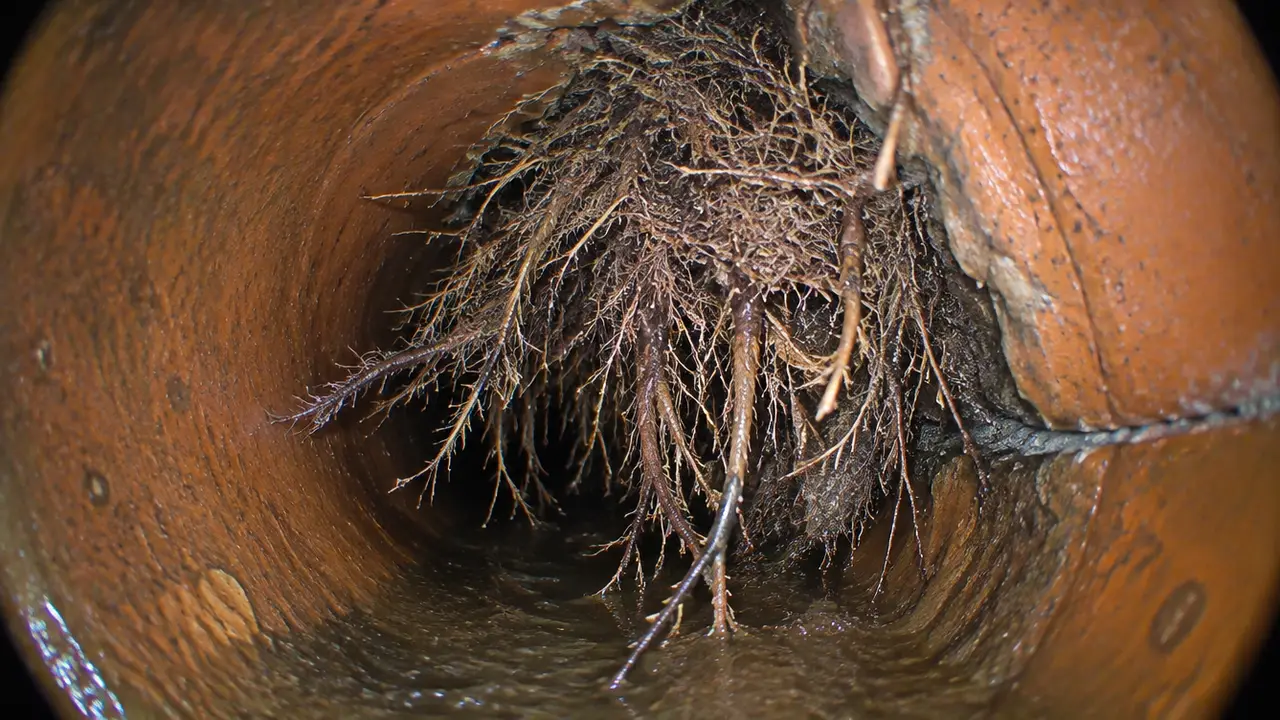
01 /Can weeping tile get clogged?
Yes, and it is one of the most common reasons an older foundation drain stops working. A drain that is meant to let water in through hundreds of small openings will also let in whatever the water carries, and it runs slowly enough that heavy particles settle. Over years, the deposits narrow the pipe until it overflows at its low points, or they seal the openings until water cannot get in at all.
Not every "clogged weeping tile" is actually clogged. A failed pump, a frozen discharge line or a broken section can produce the same wet floor. Before booking a flush, run through the quick checks in the Weeping Tile Problem Finder; it ranks thirteen causes from what you have seen and gives the next test for each.
02 /What are the signs of clogged weeping tile?
- Water at the wall–floor joint on several walls after heavy rain or melt, especially if it was dry for years before.
- A dry or nearly dry sump pit while the basement floor is wet, which means water is not reaching the pit through the tile.
- Mud, sand or silt in the bottom of the pit that returns after cleaning.
- Orange, rust-brown or gelatinous slime in the pit, on the pump screen or at the discharge outlet.
- Water standing in a cleanout riser well above the level of the pit.
- A pump that runs less than it used to in the same kind of weather.
One wet wall is a different pattern. A single wet corner or wall usually lines up with a downspout, a low spot in the grading, a window well, or a crushed or root-filled section of tile on that side. Surface water is the cheapest cause to rule out: the City of Calgary’s lot drainage guide asks for ground that falls at least 4% over the first 1.2 m from a foundation, and downspouts that extend 1.2 to 1.8 m from the wall.
03 /Why does weeping tile fill with silt?
Because fine soil reached the openings. That happens when the pipe was laid without a filter in soil that washes easily, when the filter fabric or sock tore during backfill, when the stone around the pipe was dirty to begin with, or when a joint separated and let soil fall straight in. Clay tile with open joints is especially prone, because every joint is a gap several millimetres wide.
On camera, silt looks like a smooth bed of sand or mud along the bottom of the pipe, deepest at low spots and just upstream of joints and fittings. If the pipe is otherwise sound, jetting clears it. The more useful question is why it got in; a camera will often show a torn sock, a separated joint or a section where the stone has been replaced by soil. The sock and filter fabric guide explains which filter suits which soil.
04 /What is iron ochre in weeping tile?
Iron ochre is a slimy orange to rust-brown deposit made by bacteria. Michigan State University Extension explains the chemistry: when groundwater sits long enough to run short of oxygen, bacteria turn insoluble iron in the soil into a dissolved form. When that water enters a drain pipe, where there is oxygen again, other bacteria turn the iron back into an insoluble deposit mixed with their own slime. The result coats slots, fills corrugations, seals filter fabric and can plug a sump pump and its discharge line.
| Ferrous iron (test strip) | Ochre potential |
|---|---|
| More than 25 mg/L | Very high |
| 10 to 25 mg/L | High |
| 5 to 10 mg/L | Moderate |
| 1 to 5 mg/L | Low |
| Less than 1 mg/L | Negligible |
An iron indicator test strip dipped in water from the sump pit gives a quick first read; MSU notes that testing soil for total iron is not useful, because most of it is in forms that never move. The soils with the highest ochre potential in that bulletin are fine sand, silty sand, organic soils and mineral soils mixed with organic matter; silty clays and clays have the least.
Ochre can be temporary or permanent. When the iron comes from the soil right around the new drain, MSU describes the problem peaking in the first few years and then declining. When iron-rich groundwater flows in from elsewhere, it can be permanent and needs ongoing maintenance. A 1988 bulletin from the British Columbia Ministry of Agriculture and Food adds the practical warning that ochre left to age and harden can become virtually impossible to remove, so early and regular flushing matters.
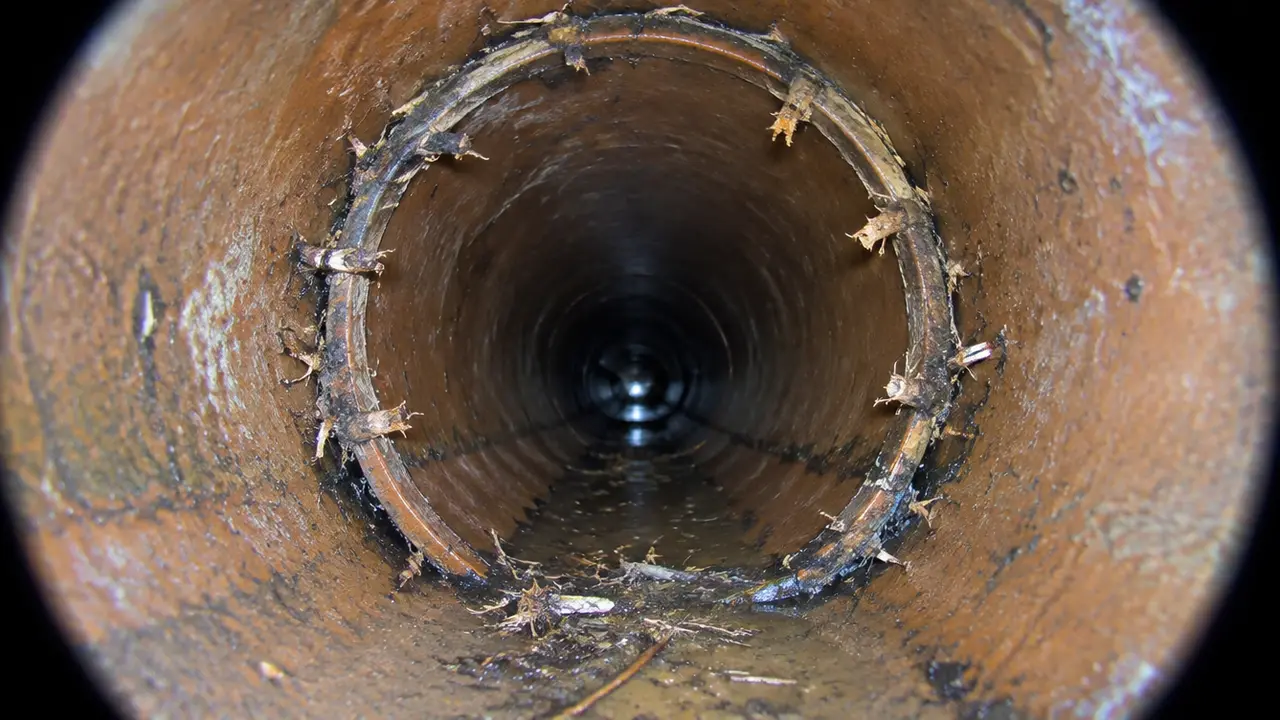
05 /How do roots get into weeping tile?
Through joints and slots, following moisture. Tile carries water all year, and fine root hairs from nearby trees and large shrubs find the openings, grow inside and branch into a mat that catches silt. Clay tile, with an open joint every section, is the most vulnerable; plastic pipe with a sock resists better but is not immune where it runs close to a mature tree.
Roots are cut with a rotating cutter head or a root-cutting jetter nozzle, then flushed out. Cutting reopens the pipe but does not close the entry point, so roots return. If the camera shows roots at the same few joints each time, replacing that stretch with continuous plastic in fresh stone is usually the lasting fix; see collapsed weeping tile repair for how a spot repair is done.
06 /How is clogged weeping tile cleared?
- Rule out the outlet
Pour water into the pit to test the pump, then follow the discharge outside and look for ice, a crushed hose or an outlet that soaks back to the wall.
- Camera first
A push camera from the pit or a cleanout shows whether the pipe is continuous and what is in it, with the distance to each problem.
- Flush from the lowest access
A jetter nozzle is fed up the tile from the pit or a cleanout. Its rear jets pull it forward while loosened material washes back down to where it can be removed.
- Match pressure to the pipe
Old clay and thin plastic tile, and loose sandy ground around them, need gentler settings than a sewer line.
- Camera again
A second run shows what came out, what is left, and any break the deposit was hiding.
- Plan the next flush
Ochre and silt return. Note what was found and when, and book the next clean before it hardens.
For fresh ochre, MSU also describes a low-pressure method used in field drains: block the outlet, fill the pipe with water, then release it suddenly so the rush of water carries the soft deposit out. It works best where the pipe has a good fall. The full process, access points and what to ask for are in weeping tile camera inspection and flushing.
07 /What does it cost to clear weeping tile, and when is cleaning not enough?
As CAD 2026 planning estimates on this network, a standalone camera inspection runs about $250 to $450, and a visit that combines a camera run with jetting from the sump about $400 to $1,200, depending on access, length and how heavy the deposit is. Cleaning is not enough when the camera shows a crushed or separated pipe, when the tile has no stone or filter around it and will silt again quickly, or when roots return to the same joints within a season.
At that point the choice is repair of one section, or a new system outside or inside the footing. The cost page lists the ranges, and the Interior vs Exterior Weeping Tile tool compares the two routes for your house.
FAQQuestions people ask
How can I tell if my weeping tile is plugged or just my pump?
Test the pump by pouring water into the pit. If it pumps and water leaves outside, but the pit stays dry in rain while the floor gets wet, the tile is the likelier problem.
Can I flush weeping tile with a garden hose?
A hose run into a cleanout can show whether water flows to the pit, and it may move a little loose silt. It will not clear packed silt, roots or hardened ochre.
What does orange slime in my sump pit mean?
It is usually iron ochre, produced by iron bacteria. It can clog the tile, the pump and the discharge line, and it is easiest to remove while it is fresh.
Will iron ochre go away on its own?
Sometimes it declines over several years when the iron comes from the local soil. Where iron-rich groundwater keeps arriving, it can be a permanent maintenance issue.
How often should weeping tile be flushed?
There is no fixed interval. Tile in clean, filtered stone may never need it; ochre-prone systems may need regular cleaning. Base the schedule on what each camera run finds.
NETWORKGo deeper across the HAUSE Sewer network
Hydro jetting weeping tile: how foundation drains are cleaned, and when they cannot be
Hydro jetting weeping tile explained: how foundation drains clog with silt, roots and iron ochre, how they are jetted from the sump, and when to replace them.
PipeCleaning.caWashing machine drain pipe: where it is, what size it is and how to clean it
Washing machine drain pipe guide: where the standpipe or laundry tub drain is, what size it should be, why it overflows, and how to clean out lint and scum.
DrainAugering.caWhy your drain snake is not working, and how to get it past the bend
Drain snake not working? Why a cable will not go down the drain, stalls at a 90-degree bend, spins without clearing or gets stuck, and how to fix each one.